

How to Run a Cash-Pay Therapy Practice
A cash-pay therapy practice is paid directly by clients instead of insurers, which means setting a sustainable fee, giving self-pay clients a Good Faith Estimate, offering superbills so clients can claim out-of-network benefits, and collecting payment up front. Done well, it trades panel rates and claims work for fewer, better-paid sessions.
A cash-pay therapy practice is paid by clients directly rather than by insurance panels. To run one well you set a fee that sustains you, give self-pay clients a Good Faith Estimate, provide superbills so clients can claim out-of-network benefits, and collect payment at booking or through prepaid packages.
It is a common model. In the American Psychological Association's 2024 Practitioner Pulse Survey, 34% of psychologists said they do not accept any form of health insurance, and among those who left or never joined networks, 82% cited insufficient reimbursement rates (reported 10/08/2025; APA report).
Cash-pay therapy practice vs in-network: the trade-off
| In-network | Cash-pay therapy practice | |
|---|---|---|
| Who sets the rate | The insurer | You |
| Paperwork | Claims, authorizations, denials, audits | Receipts and superbills |
| When you are paid | Weeks after the session | At booking or before the session |
| Client cost | Copay or coinsurance | Your full fee, partly reimbursable out of network |
| Diagnosis on record | Required for every claim | Only if the client wants a superbill |
| Caseload needed for the same income | Higher | Lower |
| Marketing needed | Less; the insurer's directory sends clients | More; you must attract clients |
The last row is the real cost. Private pay therapy replaces claims work with marketing work, and practices that skip the marketing struggle.
Step 1: set a fee that sustains the practice
Work backward from the income you need, not forward from what others charge:
- Annual income target plus practice costs (rent, software, insurance, licensing, continuing education, taxes).
- Realistic sessions per week after cancellations, admin time and vacation.
- Divide to get the fee per session.
Then check it against your local market. Our guide to setting therapy session rates and the session rate calculator walk through the numbers.
Decide in advance whether you offer reduced-fee spots, how many, and on what criteria, so a sliding scale stays a choice rather than a drift.
See it with your own practice
Prexella runs booking, superbills, the client portal and marketing in one system on your own domain. A live demo takes 30 minutes.
Step 2: give a Good Faith Estimate
Under the No Surprises Act, providers generally must give uninsured or self-pay clients a Good Faith Estimate of expected charges when they schedule care at least three business days in advance or ask for one, and clients may be able to dispute a bill that is at least $400 more than the estimate (CMS).
For therapy, practices usually estimate a reasonable number of sessions at the agreed fee and update the estimate if the plan changes. Build it into your intake packet so it is never forgotten.
Step 3: make out-of-network reimbursement easy
Many clients have out-of-network benefits and will choose a cash-pay therapist if they can get part of the fee back. Your job is to give them a superbill that their insurer accepts.
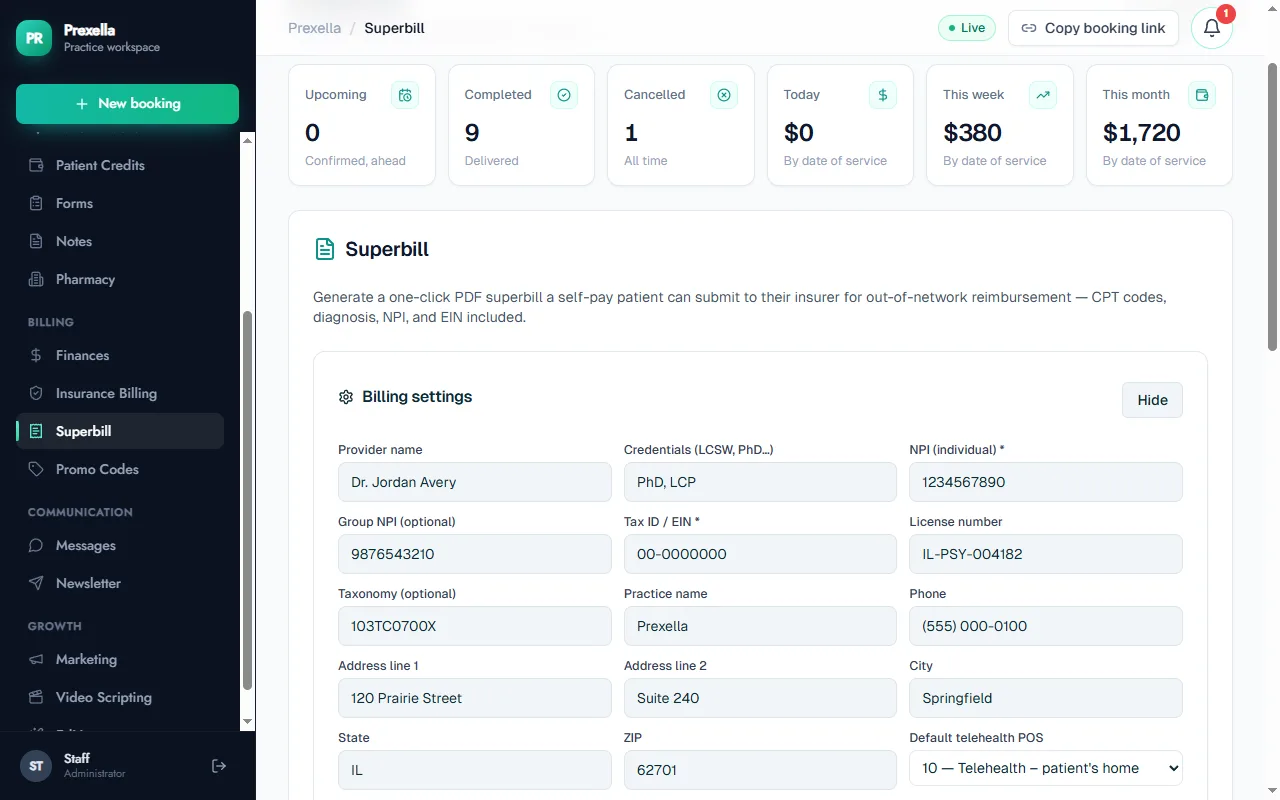
A superbill usually needs your name, credentials, NPI, tax ID or EIN, practice address, the client's details, dates of service, CPT codes, ICD-10 diagnosis codes, place of service, and the amounts charged and paid. Common psychotherapy codes include 90791 for the intake evaluation and 90834 or 90837 for 45- or 60-minute sessions. See how to create a superbill for the full checklist.
Prexella generates superbills in one click from completed sessions. Your NPI, EIN, license number and taxonomy are stored once in billing settings, CPT codes are suggested from each session's length, and you add the diagnosis before downloading the PDF.
Clients also appreciate a short explainer on how out-of-network claims work; ours is out-of-network reimbursement for therapy clients.
Step 4: collect payment up front
The cash flow advantage of a cash-pay practice disappears if you invoice after sessions. Two patterns work:
- Pay at booking. The client pays by card when they book. No invoices, no chasing.
- Prepaid packages. The client buys a block of sessions; each completed session draws one down. Therapy packages suit weekly clients and fixed-length programs.
Prexella supports both. Clients pay by card at booking, or buy session credits in the client portal. Clients with zero or one credit left get an automatic reminder three days before their next session, and a cancellation or no-show within 48 hours applies your credit penalty. You see every balance on the dashboard.
A worked fee example
Here is the backward calculation for a hypothetical solo therapist. Replace every number with your own.
| Line | Example |
|---|---|
| Target take-home income | $90,000 |
| Practice costs (rent, software, insurance, licensing, CE, marketing) | $18,000 |
| Self-employment and income tax allowance | $30,000 |
| Revenue needed | $138,000 |
| Weeks worked per year | 46 |
| Paid sessions per week, after cancellations | 20 |
| Paid sessions per year | 920 |
| Fee needed per session | $150 |
These figures are illustrative, not a recommendation or a market rate. Two levers matter most: the number of weeks you actually work, and the share of booked sessions that are paid. A cancellation policy that is applied consistently protects the second.
Talking about fees with clients
Clients who are used to copays need a clear explanation. A short script for the first call or the booking page:
- State the fee plainly. "My fee is $150 for a 50-minute session, paid when you book."
- Explain reimbursement. "Many plans reimburse part of this as an out-of-network benefit. I provide a superbill each month you can submit."
- Suggest they check their benefits. Their out-of-network deductible, coinsurance and whether they need pre-authorization.
- Mention packages if you offer them, and your cancellation policy.
Saying it the same way every time, in writing on your booking page and in your financial policy, avoids surprises later.
Step 5: going out of network if you are paneled now
If you are leaving panels, sequence it:
- Read each payer contract's termination clause and notice period.
- Decide your exit date and stop taking new in-network clients before it.
- Tell existing clients early, in writing, with their options: continue at your fee with superbills, a transition rate, or a referral to an in-network clinician.
- Send termination notices to each payer as the contracts require.
- Set up superbills and payment at booking before the first private-pay session.
Expect some clients to leave. Plan your marketing so new private-pay clients replace them.
Structuring therapy packages
Packages work best when they are simple. A few patterns cash-pay practices use:
- Monthly blocks. Four sessions bought at the start of each month for weekly clients. Simple, predictable, and easy to explain.
- Program packages. A fixed number of sessions for a defined program, such as a six-session parenting course or an eight-session skills group.
- Intake bundles. An intake session plus the first few sessions, so new clients commit to a meaningful start.
Decide upfront what happens to unused sessions, whether packages expire, and how refunds work if treatment ends early, and put it in your financial policy. Many practices avoid steep discounts on therapy packages so that a package is a convenience rather than a pressure to commit.
Records and admin for a cash-pay practice
Fewer claims does not mean less record-keeping. Keep a receipt for every payment, a ledger of credits bought and used, your Good Faith Estimates and the superbills you issued. These support clients' reimbursement claims and HSA or FSA records, and your own tax filings. Keep clinical records for as long as your state and profession require, which is unrelated to how the client paid.
Step 6: market like a private practice
Without an insurer's directory, you need your own pipeline: a booking page on your own domain, a complete Google Business Profile, referral relationships and a newsletter. Our guide to marketing a private practice covers a five-hour monthly routine.
Choosing software for a cash-pay practice
Therapist practice management software built for insurance puts claims at the center. A cash-pay therapy practice needs something different. Medical practice management software, doctor practice management software and most healthcare practice management software are built around claims and coding, and clinic management software for multi-provider medical clinics adds features a solo therapist will never use. When comparing therapy practice management software or broader patient management software, check for:
- Card payment at booking.
- Prepaid packages or session credits with balances.
- One-click superbills with NPI, EIN, CPT, ICD-10 and place of service.
- Late-cancellation and no-show rules that apply automatically.
- Intake, consent and financial policy forms signed online.
- Your own branding and domain, since you are marketing yourself.
- Pricing that does not jump with every clinician you add.
Prexella is built around exactly that list for private-pay therapists and counselors, with a flat fee for the practice. See how it works for therapists and counselors, or book a free demo.
Is a cash-pay therapy practice right for you?
Private pay suits clinicians who are willing to market, comfortable naming a fee and holding a cancellation policy, and practicing in an area or niche where enough clients can pay or claim out-of-network benefits. It suits less well a clinician whose ideal clients rely on in-network coverage, or who wants a steady stream of referrals without marketing. Many practices land in between: mostly private pay, with a small number of in-network panels or reduced-fee spots kept on purpose. Decide which mix fits your goals and your community, then build the systems above around it.
The bottom line
A cash-pay therapy practice trades insurance paperwork for control over your fee and your schedule. Set a fee from your real costs, give a Good Faith Estimate, make out-of-network reimbursement easy with clean superbills, collect up front with card payment or packages, and put real effort into marketing. Get those five right and private pay is a more sustainable model than panel work for many clinicians.
Run your practice from one screen
Booking, superbills, the client portal and marketing on your own domain. See it in a free, one-on-one demo.