

How to Set Therapy Rates for Your Private Practice
Most therapists set a fee by looking at what colleagues charge. A better starting point is the number your practice has to earn per session to pay you, and that is simple arithmetic.
To work out how to set therapy rates, add your target income, practice overhead and taxes, then divide by the number of sessions you will actually hold in a year after cancellations, holidays and admin time. Compare the result with your local market and your positioning, and set a fee you can hold for at least a year.
The rest of this guide walks through that math with a worked example, then covers sliding scales, packages, intake fees and raising rates.
How to set therapy rates in five steps
Step 1: Decide what you need to earn
Start with the salary you want to pay yourself before tax, then add what you will owe as a self-employed person. As a reference point, the US Bureau of Labor Statistics reports that the median annual wage for substance abuse, behavioral disorder and mental health counselors was $59,190 in May 2024 (BLS Occupational Outlook Handbook, checked 10/10/2026). Employed salaries come with benefits and no overhead; private practice income has to cover both.
Step 2: Add your overhead
List everything the practice pays for in a year: rent or a share of an office, liability insurance, licensing and continuing education, practice software, video platform, payment processing, an accountant, marketing, and health insurance and retirement contributions you would otherwise get from an employer.
Step 3: Count your real sessions
This is where most fee plans go wrong. Count:
- Weeks you will actually work (subtract vacation, holidays, sick days and conferences)
- Sessions per week you can sustain, not your best week
- A cancellation and no-show allowance (if you do not charge late-cancel fees, this matters more)
Step 4: Divide
Required revenue ÷ real sessions per year = your break-even rate.
Step 5: Check it against the market
Look at what therapists with similar credentials and specialties charge in your area, and at how your clients pay. A rate far above the local market needs a clear specialty or format to justify it; a rate far below it usually signals inexperience to the clients you most want.
A worked example
The figures below are illustrative; replace them with your own, or use the free session rate calculator.
| Line | Amount |
|---|---|
| Target pre-tax salary | $95,000 |
| Self-employment tax and benefits allowance | $25,000 |
| Practice overhead (rent, insurance, software, marketing) | $24,000 |
| Revenue needed per year | $144,000 |
| Working weeks per year | 46 |
| Booked sessions per week | 22 |
| Cancellation and no-show allowance | 8% |
| Sessions actually held per year | 46 × 22 × 0.92 ≈ 931 |
| Break-even rate | $144,000 ÷ 931 ≈ $155 |
At $155, every session pays its share of salary and overhead. At $175, the extra $20 covers growth, a slower month or a few sliding-scale clients.
See it with your own practice
Prexella runs booking, superbills, the client portal and marketing in one system on your own domain. A live demo takes 30 minutes.
Intake, couples and longer sessions
Many practices set different fees by session type:
- Intake sessions take longer and include assessment, so they are often priced higher. On a superbill they usually carry CPT 90791.
- Couples and family sessions (CPT 90847) are often priced above individual sessions because of the added complexity.
- Extended sessions of 53 minutes or more (CPT 90837) are priced above the standard 45-minute session (CPT 90834).
If clients claim out-of-network benefits, your session lengths and codes need to line up, because the code on the superbill has to match the time spent.
Sliding scales and reduced fees
A sliding scale makes therapy accessible to clients who cannot afford your full rate. To keep it sustainable:
- Decide how many sliding-scale slots you hold, and stick to it.
- Publish the criteria and the range, so the conversation is short and fair.
- Recalculate your full rate so that it covers the difference.
- Review sliding-scale arrangements on a set schedule, such as every six months.
Prepaid packages
Packages, such as four or eight sessions paid in advance, smooth cash flow and nearly eliminate unpaid sessions. In Prexella, clients buy session credits in the client portal and each completed session draws one down, with a low-balance reminder before they run out. Keep the per-session price inside a package close to your standard fee; deep discounts train clients to wait for deals and complicate superbills.
Good faith estimates for private-pay clients
Private-pay clients are generally entitled to a good faith estimate of expected charges. Under the No Surprises Act, uninsured and self-pay people receive one when they schedule care at least three business days in advance, can request one at any time, and may be able to dispute a bill that is at least $400 more than the estimate (CMS No Surprises, checked 10/10/2026). Your fee schedule is the basis for those estimates, so keep it written down and current.
Raising your rates
Rates that never change lose value to inflation every year. A simple policy:
- Review fees once a year, on the same month.
- Raise new-client rates first; they never knew the old rate.
- Give current clients written notice, often 30 to 60 days.
- Decide in advance whether long-term or sliding-scale clients keep their rate.
Most clients accept a reasonable increase with notice. The ones who cannot afford it can be offered a sliding-scale slot if you have one open.
Collecting what you charge
A rate only matters if you collect it. Three habits close the gap:
- Card on file or payment at booking, so there is nothing to chase.
- A late-cancellation policy in your informed consent, applied consistently.
- Monthly superbills sent without being asked, so out-of-network clients see money coming back.
Large clinics handle collections through medical practice management software or doctor practice management software staffed by billing teams. A solo or small group practice needs the same discipline with less overhead. Healthcare practice management software and clinic management software designed for in-network billing are rarely a good fit for private pay; therapist practice management software that takes card payment at booking, sells packages and builds superbills from the calendar does more with less.
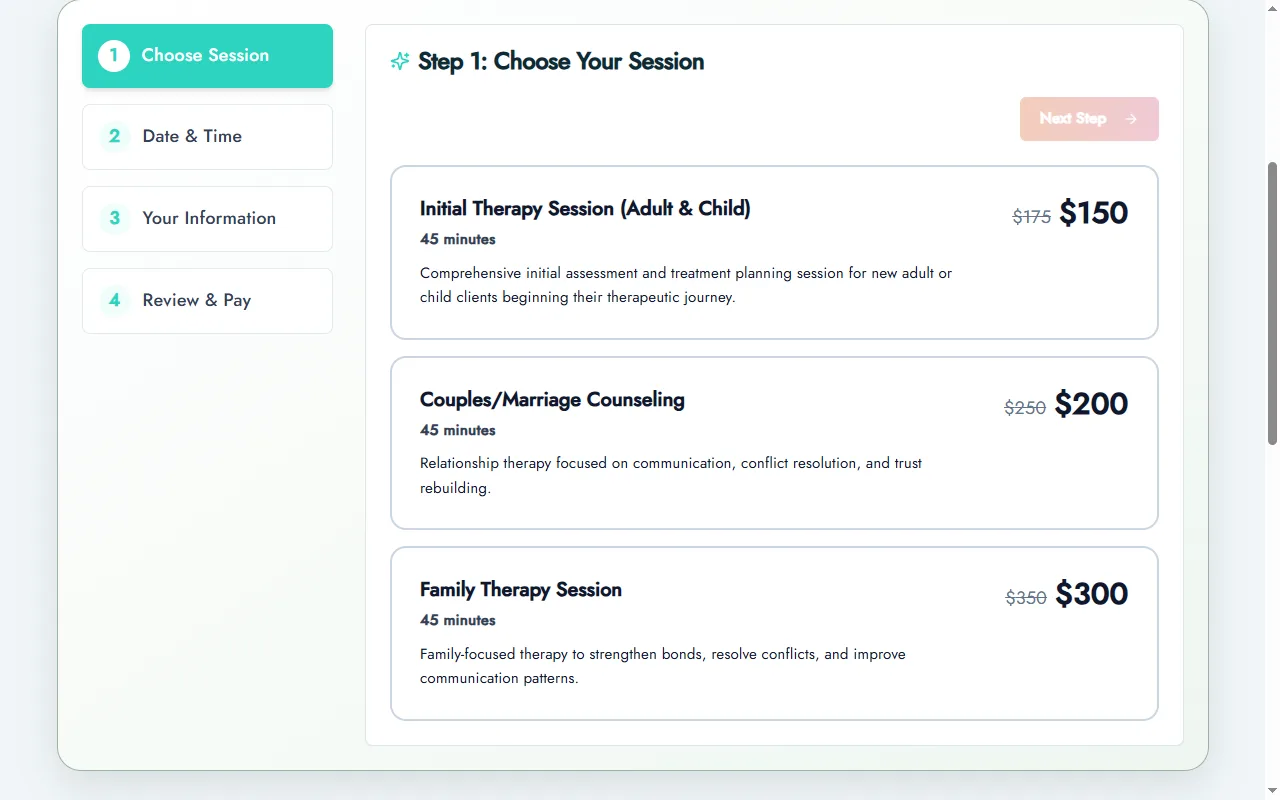
In Prexella, each session type has its own price on the booking page, clients pay by card when they book, and every payment lands on the client's record in the same patient management software view as their sessions and superbills. That is the practical side of therapy practice management software: the fee you set is the fee you collect.
Telehealth and in-person rates
Many therapists charge the same fee for telehealth and in-person sessions, because the clinical work and the time are the same. Some charge less for telehealth to reflect lower overhead, or more for in-person to reflect the cost of office space. Whatever you choose, keep the CPT code tied to the session length, not the format; the format shows up in the place of service code on the superbill, not in the fee.
Common mistakes when setting therapy rates
- Planning around a full week. Holidays, cancellations and admin time mean you will hold fewer sessions than your calendar suggests.
- Forgetting the employer half. Self-employment tax, health insurance and retirement are now yours to fund.
- Pricing from fear. A rate set low to fill the calendar fast is hard to raise later and attracts clients who are most price-sensitive.
- Discounting packages heavily. A 30% package discount on your whole caseload is a 30% pay cut.
- Never reviewing. A fee set five years ago has lost value to inflation every year since.
How to talk about your fee
State your fee on your website, in the booking flow and in your informed consent, so nobody is surprised at the first session. On the consultation call, say it plainly ("My fee is $175 per 50-minute session") and explain how out-of-network reimbursement and superbills work. Clients who understand their benefits are far less likely to stop for cost reasons. Our guide to out-of-network reimbursement for therapy can go in your welcome packet.
Rates for group practices and associates
If you employ or contract associates, the rate calculation has a second layer: what the practice charges clients, and what it pays the clinician per session. A common structure is a percentage split of collected fees, or a flat per-session amount; either way, the practice's share has to cover rent, software, marketing, billing and the owner's time managing the team. Run the same arithmetic as above for the practice as a whole, including the associate's realistic caseload and cancellation rate, before you set the associate's client fee or their split.
Pricing software by headcount matters here too. A per-clinician software fee is a cost the practice pays for every associate, every month, whether their caseload is full or not; a flat practice fee is not. Include it in the per-session overhead when you run the numbers.
A decision checklist before you publish a new rate
- The rate covers my target salary, overhead and taxes at a realistic caseload, with a buffer
- I have checked what clinicians with similar training and specialties charge locally
- My intake, standard, extended and couples fees are written down
- My informed consent states the fees, the late-cancellation fee and how fee changes are communicated
- My booking page and website show the same fees
- I can produce a good faith estimate from my fee schedule for any self-pay client
- I know how many sliding-scale slots I can hold
- Current clients have written notice of any change, with a date
- I have a date in my calendar to review fees again next year
Worked example: a part-time practice
The same arithmetic works for a part-time practice. Suppose a clinician works 3 days a week alongside an agency job and wants the practice to add $40,000 a year before tax.
| Line | Amount |
|---|---|
| Target added income | $40,000 |
| Tax and benefits allowance | $9,000 |
| Overhead (shared office one day a week, software, insurance) | $9,500 |
| Revenue needed | $58,500 |
| Sessions held per year (45 weeks × 12 sessions × 0.9) | 486 |
| Break-even rate | about $120 |
At $150, the part-time practice has room for a few sliding-scale clients and a slower summer. The point is not the specific numbers but the habit: do the math before you pick a number.
A fee schedule template
Write your fees down in one place and keep it current. It is the source for your website, booking page, informed consent and good faith estimates.
| Service | Length | CPT code on superbill | Fee |
|---|---|---|---|
| Intake assessment | 60 min | 90791 | $ |
| Individual session | 45 min | 90834 | $ |
| Extended individual session | 60 min | 90837 | $ |
| Couples or family session | 50 min | 90847 | $ |
| Late cancellation or no-show | n/a | Not billed to insurance | $ |
| Sliding-scale range | 45 min | 90834 | $ to $ |
Putting it together
Set your rate from your real numbers, give it a buffer, and write down a fee schedule for intake, standard, extended and couples sessions. Revisit it every year. See how Prexella handles pricing, packages and payment for therapists and counselors, or request a demo.
Run your practice from one screen
Booking, superbills, the client portal and marketing on your own domain. See it in a free, one-on-one demo.