

Out-of-Network Reimbursement for Therapy: A Guide to Share With Clients
Clients who understand their out-of-network benefits stay in private-pay therapy longer. This guide explains the math in plain language, with a script for the call to their insurer.
Out-of-network reimbursement for therapy means you pay your therapist directly, then submit a superbill to your health plan, which pays you back part of the fee once your out-of-network deductible is met. How much you get back depends on your plan's deductible, coinsurance and the amount it allows for each session code.
Therapists: this guide is written for your clients. Share the link, or copy the sections you need into your welcome packet.
Why so many therapists are out of network
If your therapist does not take your insurance, you are not unusual. In an analysis of commercial claims, Milliman found that behavioral health office visits were 5.4 times as likely to be out-of-network as medical and surgical office visits in 2017, and that insurers paid primary care office visits on average 23.8% more than behavioral health visits (Milliman report via The Kennedy Forum, November 20, 2019). Lower in-network rates are one reason many therapists choose private pay.
Out-of-network benefits are how a private-pay arrangement can still be partly covered.
How out-of-network reimbursement for therapy works
The process has four steps:
- You pay your therapist their full fee at each session.
- Your therapist gives you a superbill, usually monthly, listing each session with the codes your insurer needs.
- You submit the superbill to your insurer as an out-of-network claim, usually through the member website, an app or by mail.
- Your insurer reimburses you according to your plan's out-of-network benefits.
Free superbill generator
Fill in your provider and session details and download a clean superbill PDF. It runs in your browser; no client data is sent to us.
See it with your own practice
Prexella runs booking, superbills, the client portal and marketing in one system on your own domain. A live demo takes 30 minutes.
The four numbers that decide your reimbursement
Out-of-network deductible
The amount you pay before the plan starts reimbursing. Many plans have a separate, higher deductible for out-of-network care.
Coinsurance
After the deductible, the share the plan pays. A plan that pays 60% coinsurance out of network pays 60% of its allowed amount; you cover the rest.
Allowed amount
The amount the plan recognizes for a service code. It is often lower than your therapist's fee. If your therapist charges $180 and the allowed amount is $120, reimbursement is calculated on $120.
Out-of-pocket maximum
The most you pay in a year before the plan pays 100% of allowed amounts. Out-of-network maximums may be separate from in-network ones.
A worked example
This example is illustrative, not a quote for any plan.
| Item | Amount |
|---|---|
| Therapist's fee per session | $180 |
| Plan's allowed amount for CPT 90837 | $120 |
| Out-of-network coinsurance after deductible | 60% |
| Reimbursement per session | 60% × $120 = $72 |
| Your net cost per session | $180 − $72 = $108 |
Until the out-of-network deductible is met, reimbursement is $0, but every session's allowed amount counts toward the deductible. That is why submitting superbills even early in the year matters.
Questions to ask your insurer
Call the member services number on your card and ask:
- Do I have out-of-network benefits for outpatient mental health?
- What is my out-of-network deductible, and how much have I met this year?
- What is my out-of-network coinsurance for outpatient psychotherapy?
- What is the allowed amount for CPT code 90791 (the intake), and for 90834 or 90837 (ongoing sessions)?
- Do telehealth sessions have the same out-of-network benefit as office sessions?
- Is pre-authorization required for out-of-network therapy?
- How do I submit a claim, and what is the filing deadline?
Write down the date, the representative's name and a reference number.
What a complete superbill includes
A superbill your insurer can process has your therapist's name, credentials, individual NPI, tax ID and address; your name and date of birth; an ICD-10 diagnosis code; each date of service with its CPT code, place of service and fee; and what you paid. Telehealth sessions from home use place of service 10, "Telehealth Provided in Patient's Home," in the code set CMS maintains (CMS place of service codes, checked 10/10/2026). Therapists can find the full field list in how to create a superbill.
A superbill includes a diagnosis. Some clients prefer not to have a diagnosis on file with their insurer and choose not to submit; that is a decision to discuss with your therapist.
Common reasons claims come back
- Name mismatch. The name on the superbill must match the insurance card.
- Missing NPI or tax ID. Ask your therapist to reissue.
- Date ranges instead of individual dates. Each session should be its own line.
- Telehealth coded as an office visit. The place of service should reflect where the session took place.
- Late filing. Plans set deadlines for out-of-network claims; monthly submission avoids missing them.
Good faith estimates
If you are paying for therapy yourself rather than through in-network insurance, you are generally entitled to a good faith estimate of expected charges. Under the No Surprises Act you receive one when you schedule care at least three business days in advance, can request one at any time, and may be able to dispute a bill that is at least $400 more than the estimate (CMS No Surprises, checked 10/10/2026).
Telehealth and out-of-network benefits
Most plans that cover out-of-network outpatient mental health also cover telehealth sessions, but not always at the same rate, and some plans have their own rules for video visits. Ask member services specifically about telehealth if most of your sessions are online. On the superbill, telehealth sessions from home carry place of service 10 rather than 11 (office), so the claim matches what actually happened.
How to track your reimbursements
Keep a simple record so nothing is lost:
| Date submitted | Sessions covered | Amount paid to therapist | Amount reimbursed | Date received | Notes |
|---|---|---|---|---|---|
| 02/03/2026 | 01/06–01/27 (4 sessions) | $720 | $0 | 02/20/2026 | Applied to deductible |
| 03/02/2026 | 02/03–02/24 (4 sessions) | $720 | $288 | 03/18/2026 | Deductible met |
Reading the explanation of benefits (EOB) that comes back with each claim tells you how much counted toward your deductible, the allowed amount per session, and what the plan paid. If an EOB shows a denial, the reason code tells you whether the problem is a missing field (fixable by your therapist) or a coverage rule (a question for your insurer).
A year of reimbursement, worked through
Here is how the numbers play out over a year for a client with an illustrative PPO plan: a $1,500 out-of-network deductible, 60% coinsurance after the deductible, and a $120 allowed amount for 90834. The therapist charges $175 and the client attends 40 sessions.
| Stage | Sessions | Allowed amount counted | Reimbursed |
|---|---|---|---|
| Meeting the deductible | 1–12 | 12 × $120 = $1,440 | $0 |
| Session 13 (deductible crossed) | 13 | $60 to deductible, $60 at 60% | $36 |
| After the deductible | 14–40 | 27 × $120 = $3,240 | 60% = $1,944 |
| Year total | 40 | $1,980 |
The client pays $7,000 in fees and gets $1,980 back, a net cost of $5,020, or about $126 a session instead of $175. Early in the year reimbursement is $0, which is when clients most often give up. Explaining this curve at intake keeps them submitting.
Step by step: submitting a claim online
- Sign in to the insurer's member website or app.
- Find "submit a claim" or "out-of-network claim," usually under claims or forms.
- Choose the patient (yourself or a dependent) and the provider type (behavioral health, outpatient).
- Upload the superbill as a PDF. Some insurers also ask for a short claim form.
- Confirm the dates of service and the amount you paid.
- Save the confirmation number and note the date.
- Watch for the explanation of benefits, usually by mail or in the member portal.
If you have two insurance plans
Clients covered by two plans, for example their own and a spouse's, usually submit to the primary plan first and then to the secondary plan with the primary plan's explanation of benefits attached. Coordination-of-benefits rules decide which plan is primary; member services for either plan can confirm the order.
Appeals
If a claim is denied for a reason you think is wrong, you can usually appeal. Ask your insurer how, and by when. A letter from your therapist describing medical necessity can support an appeal; ask before you request one, because writing it takes clinical time.
Health savings and flexible spending accounts
Clients with a health savings account (HSA) or flexible spending account (FSA) can often pay for therapy with those pre-tax funds, whether or not their insurer reimburses the session. The superbill or a detailed receipt usually serves as documentation for the account administrator. Rules on what counts as an eligible expense come from the IRS and the account's plan, so clients should check with their administrator before relying on it.
For many clients, combining the two is what makes private-pay therapy affordable: out-of-network reimbursement reduces the cost, and paying the remainder from an HSA or FSA reduces it again.
When out-of-network does not make sense
Out-of-network reimbursement works best when a client has a PPO or POS plan with a reasonable deductible. It works poorly when:
- The plan has no out-of-network benefit, as many HMO and EPO plans do not.
- The out-of-network deductible is high relative to what the client will spend in a year.
- The client does not want a diagnosis on file with their insurer.
In those cases, a sliding-scale slot, a less frequent schedule or a referral to an in-network clinician may serve the client better. Saying so openly builds trust.
For therapists: making reimbursement easy
Clients who get money back reliably stay in therapy longer, so the superbill is part of client retention, not just paperwork. Three habits help:
- Send superbills on a schedule, monthly, without being asked.
- Give the insurer script at intake, using the checklist above.
- Use a system that builds superbills from your calendar instead of retyping dates.
Large medical groups handle this through claims in their medical practice management software or doctor practice management software, with billing staff behind it. Healthcare practice management software and clinic management software built for in-network medicine rarely make out-of-network superbills easy. Private-pay practices are better served by therapist practice management software where the superbill comes straight from completed sessions, and where the patient management software record already holds the client's date of birth and diagnosis.
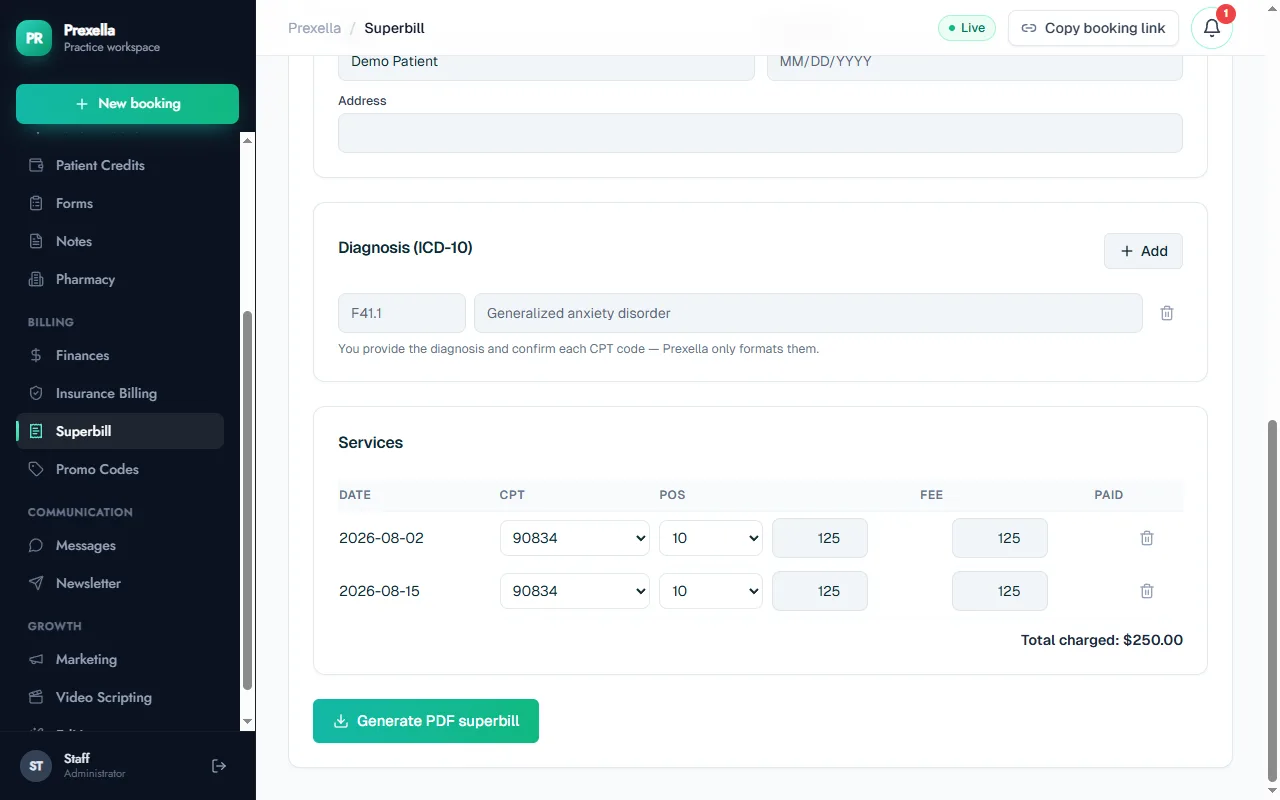
In Prexella, a superbill is generated from a client's completed sessions for any date range, with CPT codes suggested from session length, the telehealth or office place of service set from the visit type, and your NPI, EIN and license number filled in from settings. That makes it practical therapy practice management software for out-of-network practices; see how it fits therapists and clinical social workers. To try a one-off superbill now, use the free superbill generator, or request a demo to see monthly superbills generated in a minute.
Run your practice from one screen
Booking, superbills, the client portal and marketing on your own domain. See it in a free, one-on-one demo.