

Marketing a Private Practice Without an Agency
Marketing a private practice comes down to four things you can run yourself: a booking page that turns visits into appointments, a Google presence that gets found locally, referral relationships, and a follow-up channel such as a newsletter. Paid ads come last, and only once you can measure which bookings they produce.
Marketing a private practice without an agency means doing four things well yourself: a booking page that converts, a local Google presence, referral relationships, and a follow-up channel such as a newsletter. Add paid ads only after you can see which bookings each channel produces.
Demand is not the problem for many clinicians. More than half of psychologists reported having no openings for new patients in the American Psychological Association's 2024 Practitioner Pulse Survey (reported 10/08/2025). The challenge is attracting the right clients, at your rate, for the hours you want to fill, especially in a private-pay practice.
Step 1: make the booking page do the selling
Every other channel sends people to one place. If that place makes them email you, wait for a reply and play phone tag, you lose a share of everyone you worked to attract.
A booking page that converts:
- Says who you help in the first line, in the client's words, not a list of modalities.
- Shows real availability so visitors can see when they could start.
- Lets them book and pay in one flow, on a phone, at 11 p.m.
- States your fee and whether you provide superbills for out-of-network reimbursement.
- Carries your brand, on your own domain, so a client who found you on Google lands somewhere that looks like you.
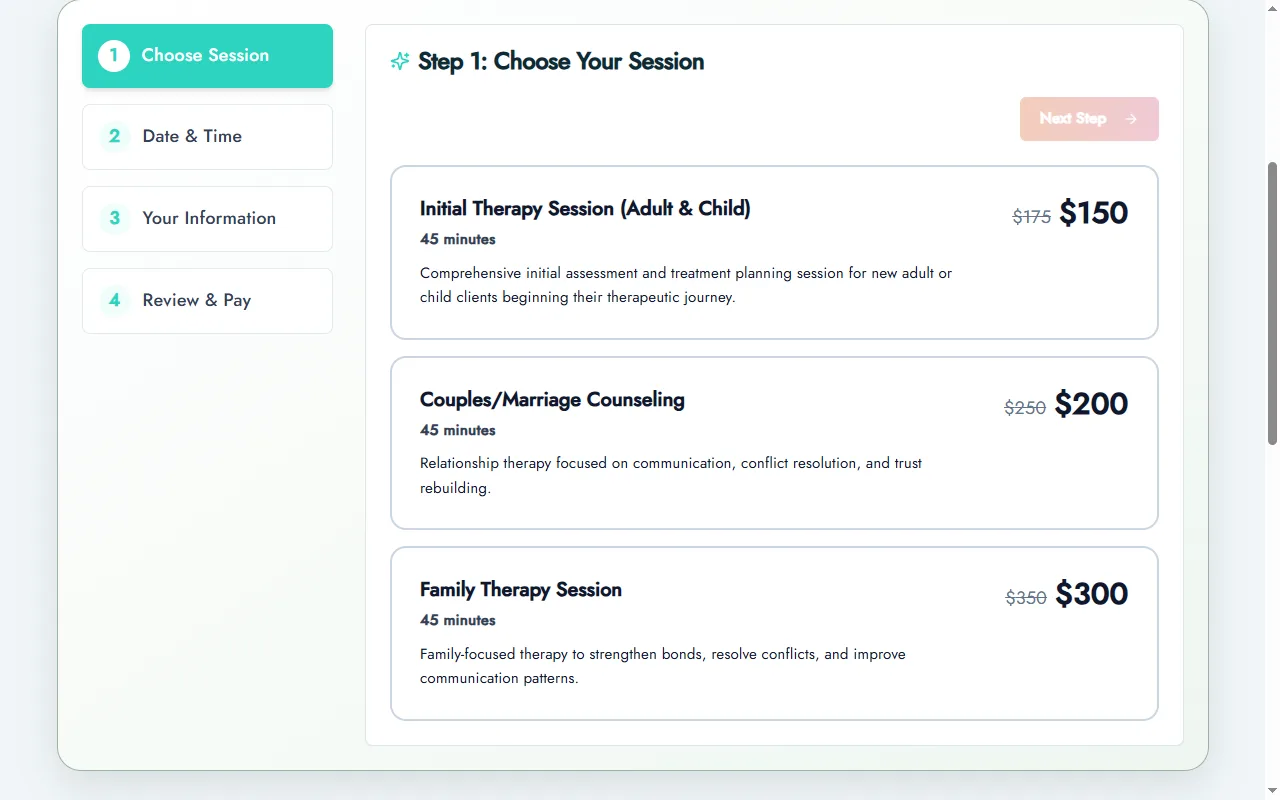
Prexella's online booking runs on your own domain under your practice name, takes card payment at booking, and guides new clients straight into the client portal for their intake forms. Because it is white-label, every link you share in marketing points to your brand, not a software vendor's.
Step 2: get found on Google
Most local clients start with a search. Three free assets do most of the work:
- Google Business Profile. Complete every field: categories, hours, telehealth availability, photos of the office, and a booking link.
- A page per service and location. "Anxiety therapy in Westchester" deserves its own page with real detail, not a line in a list.
- Directory profiles on the major therapist directories, each linking back to your booking page.
Google Ads for therapists can work, but they are expensive in competitive cities and easy to waste. Start organic, then test ads with a small budget once Step 5 is in place.
See it with your own practice
Prexella runs booking, superbills, the client portal and marketing in one system on your own domain. A live demo takes 30 minutes.
Step 3: build referral relationships
Referrals from physicians, psychiatrists, other therapists and schools convert better than any ad. A simple routine:
- Introduce yourself to five local primary care offices and pediatricians a quarter.
- Keep a short referral list of clinicians you trust, and refer out generously.
- Send a brief thank-you when a referral books (without client details unless you have authorization).
Step 4: stay in touch with a newsletter
A private practice newsletter keeps you in mind for former clients, waitlisted inquiries and referral partners. Once a month is enough: a short article, a practice update and a booking link.
Email marketing has rules. Under the CAN-SPAM Act, marketing email needs an accurate sender, a physical address and a working unsubscribe that you honor. In a health practice, also think about who is on the list: sending a "therapy practice" newsletter to a client's shared family email can disclose that they are a client.
Step 5: measure before you spend
The single most useful marketing habit is asking every new client how they heard about you, at the moment they book, and recording the answer with the booking. Compare that each month with what you spent on each channel. That is the whole of what most small practices need from customer relationship management.
You will see vendors selling CRM customer relationship management software, client management software for small business, "the best customer relationship management software" for practices, or the best customer management software for small teams. Some call it customer relation management software; others sell software customer management add-ons, or software customer relationship management CRM bundles with a website builder. A few lists rank the best client relationship management software for therapists alongside generic sales tools, and crm customer management features such as pipelines and deal stages rarely fit a practice where clients book themselves. Before you buy one, check what your practice software already does. Good CRM systems track leads and follow-ups; for a practice where clients book themselves, your booking record already holds the lead source, and a client management app inside your practice software covers the rest. Our post on CRM for private practice covers when a separate CRM is worth it.
Prexella's marketing suite
Prexella's marketing suite keeps marketing next to the calendar it is meant to fill:
- Referral tracking. Every online booking asks how the client heard about you, and the answer is saved with the booking.
- Ad performance. Record and review Meta and Google campaign results in the dashboard: spend, reach, clicks and leads. These are figures you record, not a live connection to the ad platforms.
- Content calendar. Plan posts and videos by week.
- Video scripting with AI help for short-form videos, and editing requests with comments for whoever edits them.
- Newsletters. Send branded email newsletters to your clients and list.
That covers most of what an agency would report to you each month, without the retainer.
Marketing a private practice within the rules
Marketing in health care has guardrails that general small-business advice ignores.
| Rule | What it means for you | Source |
|---|---|---|
| No fake or bought reviews | You cannot write, buy or incentivize fake reviews, or suppress negative ones | FTC final rule, 2024 |
| Endorsements must be honest | Testimonials and endorsements must reflect real experiences, with material connections disclosed | FTC Endorsement Guides |
| Client testimonials | Many ethics codes restrict soliciting testimonials from current clients | Your profession's ethics code |
| Email marketing | Accurate sender, physical address, working unsubscribe | CAN-SPAM Act |
| Website tracking | Be careful with ad pixels on booking and portal pages | HHS guidance on online tracking |
| Client privacy | Never confirm someone is a client in public replies to reviews | HIPAA and ethics codes |
The practical upshot: do not reply to a review in a way that confirms the reviewer is your client, and do not put ad-tracking pixels on pages where clients log in or fill in health information without proper advice.
What a converting booking page looks like
Here is the structure of a booking page that turns visitors into first appointments, top to bottom:
- Headline in the client's words. "Therapy for anxiety and burnout, in person in White Plains or online across New York." Not "Integrative, client-centered psychotherapy."
- One paragraph on who you help and how you work. Specific enough that the right client recognizes themselves.
- Fee and how payment works. Your session fee, whether you provide superbills, and your cancellation policy in one line.
- Telehealth or in person. Where you see clients and where you are licensed for video sessions.
- The booking flow itself. Session types, live availability, card payment.
- What happens next. "You will get a confirmation email and a link to complete your intake forms before we meet."
Every item answers a question a prospective client would otherwise email you about. Fewer emails means fewer people lost between the inquiry and the booking.
Content that brings the right clients
Content works when it answers the questions your ideal clients search for. A few formats that suit a small practice:
- Service pages for each issue you treat, with what sessions look like and who they are for.
- Location pages for each area you serve in person.
- Short videos answering one common question each, such as what the first session is like or how superbills work.
- A newsletter archive on your site, so each issue also works as a page that can be found.
Keep clinical content general and educational. Never use client stories without written permission, and be careful with anything that could identify a client.
A monthly marketing routine
| Week | Task | Time |
|---|---|---|
| 1 | Review last month's bookings by referral source and spend | 30 min |
| 1 | Update your Google Business Profile: hours, photos, a post | 20 min |
| 2 | Contact two referral sources | 45 min |
| 3 | Write and send the newsletter | 90 min |
| 4 | Record one short video or write one article for your site | 60 min |
| 4 | Decide next month's ad budget from Week 1's numbers | 15 min |
Under five hours a month, and every hour is measurable.
Reading the numbers
After three months of recording referral sources, patterns usually appear. A channel that brings plenty of inquiries but few bookings may be attracting the wrong clients, which often means the message, not the channel, needs work. A channel that brings few clients who stay for many sessions may be worth more than one that brings many who leave after one. Look at bookings and how long those clients stay, not inquiries alone.
What to stop doing
- Paying for ads you cannot measure. If you do not know which bookings an ad produced, stop until you do.
- Collecting followers instead of bookings. A small, local audience that books beats a large one that does not.
- Running five tools for one job. A scheduler, a newsletter tool, a spreadsheet of referral sources and an ad dashboard can live in one system.
The bottom line
Marketing a private practice works best as a small, steady routine you run yourself: a booking page that converts, a strong Google profile, real referral relationships, a monthly newsletter, and ads only once you can measure them. Keep it honest and within the FTC and ethics rules. If you want booking, referral tracking, newsletters and ad results in one system under your own brand, see how therapists and coaches use Prexella, or book a free demo.
Run your practice from one screen
Booking, superbills, the client portal and marketing on your own domain. See it in a free, one-on-one demo.