

Therapy Intake Form Checklist: What to Include
A therapy intake form should collect identity and contact details, an emergency contact, insurance or self-pay status, the presenting concern and relevant history, and signed consents: consent to treat, telehealth consent, the privacy notice acknowledgment and your financial and cancellation policies. Collect it before the first session, online, with signatures you can prove later.
A therapy intake form collects who the client is, how to reach them and someone else in an emergency, how they will pay, why they are seeking help and their relevant history, along with signed consents. Send it online at booking so it is complete, reviewed and signed before the first session starts.
This checklist covers each section, what to ask, and the consents that usually travel with it. Your state board and your profession's ethics code set the specific requirements, so treat this as a starting point to review against them.
Free therapist intake form template
A ready-to-use intake packet: demographics, insurance, history, consent to treat, telehealth consent, privacy acknowledgment and cancellation policy.
The therapy intake form checklist
Use this as the backbone of your intake packet. Each section below explains what to include.
- Client demographics and contact details
- Emergency contact
- Insurance details or self-pay election
- Presenting concerns and goals
- Mental health, medical and substance use history
- Current medications and other providers
- Safety screening questions
- Consent to treat (informed consent)
- Telehealth consent, if you offer telehealth
- Notice of Privacy Practices acknowledgment
- Financial responsibility and cancellation policy
- Release of information, if coordinating care
- Electronic signature and date on every signed document
1. Demographics and contact details
Legal name and preferred name, date of birth, pronouns, address, phone, email and preferred contact method. Ask whether it is safe to leave voicemails or send texts and emails, and record the answer. For clients under 18, collect the parent or guardian's details and confirm who has legal authority to consent.
2. Emergency contact
Name, relationship and phone number, plus the client's permission to contact that person in an emergency. For telehealth clients, add the client's usual physical location during sessions, because emergency procedures depend on where the client is.
3. Insurance or self-pay
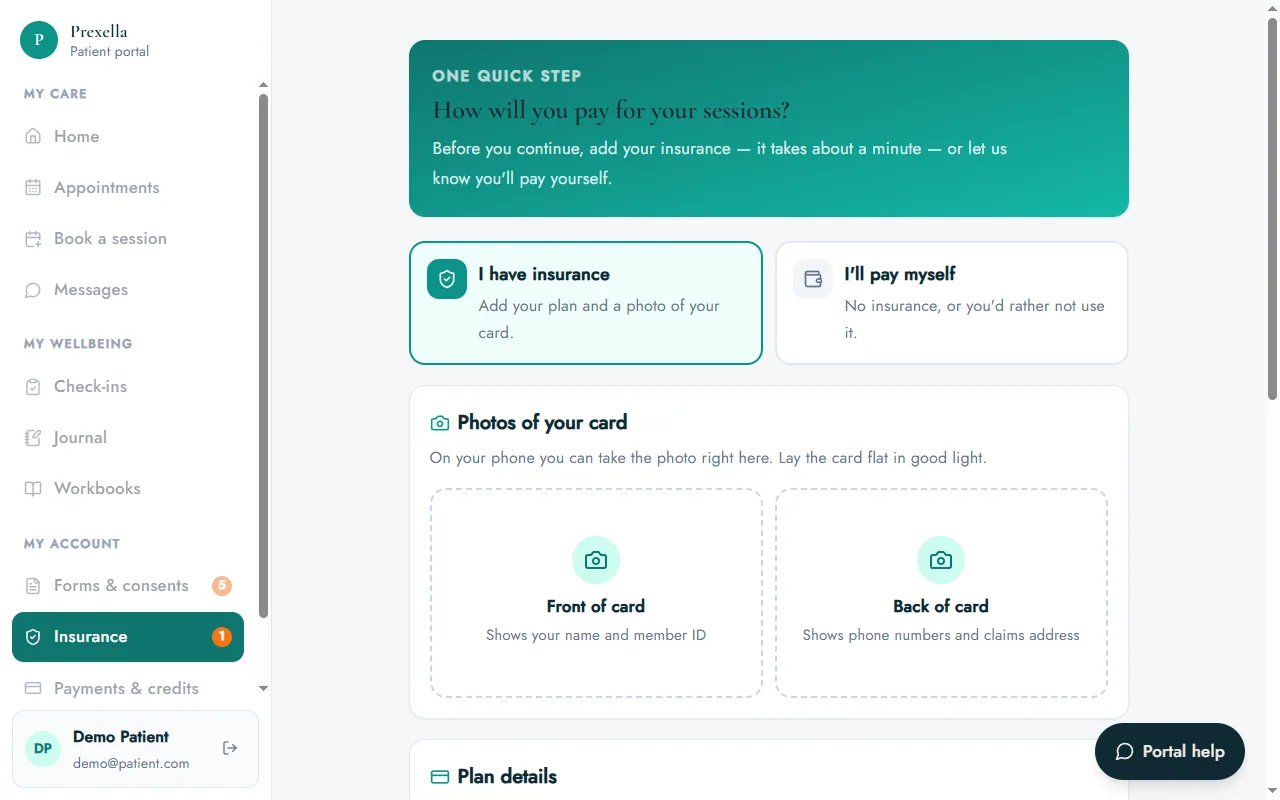
Insurance company, member ID, group number, subscriber name and date of birth, and a photo of both sides of the card. For private-pay practices, also ask whether the client wants a superbill for out-of-network reimbursement.
Self-pay and uninsured clients are generally entitled to a Good Faith Estimate of expected charges under the No Surprises Act when they schedule care in advance or ask for one (CMS). Many practices deliver it with the intake packet.
4. Presenting concerns and goals
What brings the client in, how long it has been going on, how it affects daily life, and what they hope to change. Open-ended questions work better than long checklists here.
5. History
Previous therapy or psychiatric care, hospitalizations, relevant medical conditions, substance use, family mental health history, and significant life events. Keep it proportionate: ask what you will use.
6. Medications and other providers
Current medications and prescribers, primary care provider, and any other treating clinicians, with a release of information if you plan to coordinate.
7. Safety screening
Questions about current thoughts of self-harm or harm to others, and access to means. Decide in advance how you will respond if a form submitted before the first session indicates risk, including who reviews forms and how quickly.
The consents that travel with it
The intake form gathers information. The consents are where the client agrees to how you work.
Consent to treat
Your informed consent should explain what therapy involves, your approach, the limits of confidentiality (including mandated reporting and duty-to-warn situations), how records are kept, fees and payment, and the client's right to end treatment. Professional codes set expectations here: see the APA Ethics Code or the NASW Code of Ethics for your profession.
Telehealth consent
If you offer video sessions, a telehealth consent usually covers technology and privacy risks, what happens if a session disconnects, the client's location and emergency plan, and that you can only provide services where you are licensed. The APA Guidelines for the Practice of Telepsychology are a useful reference for any profession. State rules differ; see our state pages, such as New York, for local requirements.
Notice of Privacy Practices acknowledgment
HIPAA-covered providers must give clients a Notice of Privacy Practices and make a good-faith effort to get a written acknowledgment that they received it (HHS).
Financial responsibility and cancellation policy
Your fee, how and when payment is taken, what happens with late cancellations and no-shows, and how superbills work. A signed policy turns a difficult conversation into a reference to something the client already agreed to.
Release of information
If you will coordinate with a psychiatrist, primary care provider or school, get a specific, signed authorization naming who, what and for how long.
See it with your own practice
Prexella runs booking, superbills, the client portal and marketing in one system on your own domain. A live demo takes 30 minutes.
Intake for couples, families and minors
The standard checklist assumes one adult client. Three common variations need extra care.
Couples. Each partner completes their own intake and signs their own consent. Decide and explain in writing how you handle information one partner shares privately, often called a no-secrets or limited-secrets policy, and who receives superbills.
Families. Identify who the client is: the family, a child, or a parent. That decision affects who signs consent, who can see records, and which billing code applies to each session.
Minors. Confirm who has legal authority to consent, especially with separated or divorced parents, and ask for custody documentation where it affects consent. Some states allow minors to consent to certain mental health treatment on their own from a given age.
A dedicated couples or family intake form keeps these questions from being lost inside a form written for individual adults.
Paper vs PDF vs an online client portal
| Paper | Fillable PDF | Online client portal | |
|---|---|---|---|
| Client completes before session | Rarely | Sometimes | Yes, at booking |
| Legible and complete | Often not | Usually | Required fields enforced |
| Signature evidence | Ink only | Weak | Audit trail: who, when, how |
| Storage | Filing cabinet | Email attachments | Stored with the client record |
| Reminders for unfinished forms | Manual | Manual | Automatic |
Paper works for a very small practice but is slow to review and hard to search. Emailed PDFs move health information through inboxes. Client portal software, sometimes called patient portal software or a patient management portal, solves both: the client fills in and signs the forms on your site, and they land on the client record.
How Prexella handles intake
Prexella's client portal sends new clients straight from booking into creating their portal account, where your intake packet is waiting. The standard forms include a Client Intake Form, Informed Consent for Treatment, Notice of Privacy Practices (HIPAA), Telehealth and Electronic Communication Consent, Financial Responsibility Agreement, Authorization for Release of Information, and a Couples / Family Intake Form.
- Electronic signatures are recorded with an ESIGN and UETA audit trail: the consent statement, typed name, drawn signature, timestamp, IP address and browser.
- Insurance or self-pay is collected in the portal, including both card photos, which are stored in private storage rather than at public links.
- Reminders prompt clients about unfinished forms before their visit.
- Your brand. The portal runs on your domain, so it reads as part of your practice, not a vendor's customer portal software.
Coaches and practices that do not need clinical forms can still use it as a client management portal for agreements, payments and session credits. See how therapists run the whole flow on therapist practice management.
Reviewing intake forms before session one
Collecting forms early only helps if someone reads them before the client arrives. A simple review routine:
- Set a review window. Check new intake packets within one business day of submission, and always before the first session.
- Read safety answers first. If anything indicates current risk, follow your written protocol, which may mean contacting the client before the scheduled session.
- Check consents are signed. An unsigned informed consent or telehealth consent should be resolved before treatment starts.
- Note coordination needs. If the client named another provider and signed a release, plan when you will make contact.
- Confirm payment details. Insurance details for superbills, or the self-pay election and Good Faith Estimate.
For couples and families, review each person's information separately and confirm who is the identified client, which affects consent, records and billing.
Keeping your intake packet current
Intake packets drift. Policies change, fees change, telehealth platforms change, and old versions keep circulating. Once a year, or whenever something changes:
- Re-read every form against your current policies and fee.
- Check your state board for rule changes on consent, telehealth and minors.
- Update your Notice of Privacy Practices if your practices changed.
- Record the version date on each form so you know which version each client signed.
- Decide whether existing clients need to sign an updated version.
Keeping forms in one system makes this manageable: you update the form once, and every new client receives the current version.
Common intake mistakes
- Asking for everything. Long forms get abandoned or rushed. Ask what you will use in the first sessions.
- No plan for risk answers. If a form can flag risk, someone must review it promptly.
- Unsigned consents. A consent that is not signed and dated is hard to rely on.
- Inconsistent versions. Update all copies when a policy changes, and keep the version each client signed.
- Forgetting telehealth location. Emergency procedures depend on where the client is during a session.
The bottom line
A complete therapy intake form covers identity, emergency contact, payment, the presenting concern and history, safety, and a set of signed consents, collected before the first session. Use our free intake form template as a starting point, check it against your state board's rules, and collect it through a portal that keeps signatures you can prove. To see intake, consent and e-signatures running on your own domain, book a free demo.
Run your practice from one screen
Booking, superbills, the client portal and marketing on your own domain. See it in a free, one-on-one demo.