

Using the PHQ-9 and GAD-7 in Therapy: A Private Practice Guide
Two short questionnaires, a few minutes a month, and a score you can track across treatment. Here is how to use them well, including the safety step that matters most.
Using the PHQ-9 and GAD-7 in therapy means giving clients two short, validated self-report questionnaires at intake and at regular intervals, so you can track depression and anxiety severity over time and adjust treatment when scores stall. The most important rule is clinical: any positive answer to PHQ-9 item 9 needs a prompt safety follow-up, whatever the total score.
What the PHQ-9 and GAD-7 measure
The PHQ-9 is a nine-item questionnaire about depressive symptoms over the last two weeks. Each item is scored 0 ("not at all") to 3 ("nearly every day"), for a total of 0 to 27. In its original validation study, a score of 10 or more had 88% sensitivity and 88% specificity for major depression, and scores of 5, 10, 15 and 20 represented mild, moderate, moderately severe and severe depression (Kroenke, Spitzer and Williams, Journal of General Internal Medicine, 2001).
The GAD-7 is a seven-item questionnaire about anxiety symptoms over the last two weeks, scored the same way for a total of 0 to 21. In its original validation, a cutoff of 10 gave 89% sensitivity and 82% specificity for generalized anxiety disorder (Spitzer et al., Archives of Internal Medicine, 2006).
Both are screening and monitoring tools. Neither replaces a clinical assessment.
Severity bands at a glance
| Score | PHQ-9 severity | GAD-7 severity |
|---|---|---|
| 0–4 | Minimal | Minimal |
| 5–9 | Mild | Mild |
| 10–14 | Moderate | Moderate |
| 15–19 | Moderately severe | Severe (15–21) |
| 20–27 | Severe | — |
See it with your own practice
Prexella runs booking, superbills, the client portal and marketing in one system on your own domain. A live demo takes 30 minutes.
Why use the PHQ-9 and GAD-7 in therapy
Measurement-based care
Measurement-based care means using standardized measures routinely to inform treatment. For accredited behavioral health organizations, The Joint Commission's outcome measures standard (CTS.03.01.09) requires a standardized tool to monitor each individual's progress and use of the data to inform their goals (The Joint Commission, measurement-based care FAQ). Most private practices are not accredited, but the logic carries over: a score you track gives you and the client an objective view of progress.
Better conversations
A score that has not moved in eight weeks is a prompt to review the treatment plan together. A score that has dropped is something to celebrate with the client.
Documentation
Scores in the record support medical necessity if a client later claims out-of-network benefits or you move to in-network work.
How to administer them
At intake
Give both at or before the first session, alongside the intake form, to establish a baseline.
During treatment
Pick an interval and stick to it. Common choices:
- Every session in short-term or intensive work
- Every two to four weeks in weekly therapy
- Monthly in maintenance phases
Before the session, not during it
Asking clients to complete the questionnaires in a portal before the session saves session time and gives you the score when you start. Explain who reviews the answers, when, and what the client should do in a crisis, because a portal is not monitored around the clock.
The item 9 safety step
PHQ-9 item 9 asks how often the client has had "thoughts that you would be better off dead, or of hurting yourself in some way." Any response above zero should trigger a structured safety assessment by the clinician, such as the Columbia Suicide Severity Rating Scale (C-SSRS) screener, and follow-up under your practice's safety protocol, regardless of the total score.
Build that into your workflow so it cannot be missed:
- A positive item 9 is flagged where you will see it before the next session
- A structured follow-up (such as the C-SSRS screener) is available
- Clients are told the portal is not monitored in real time and given crisis resources (988 in the US)
- Your safety protocol says who reviews flagged results and how quickly
- The follow-up is documented in the client record
Reading scores over time
A single score is a snapshot; the trend is the useful part. A common rule of thumb in measurement-based care is to treat a drop of 50% or more from baseline as response and a score below 5 on the PHQ-9 as remission. If a score has not improved meaningfully after several weeks, review the plan with the client.
When a score rises, ask about it before assuming treatment is failing: a death in the family, a job loss or a new medication can move scores for reasons outside therapy, and the conversation itself is often clinically useful. When a score falls quickly, check that the client is not simply answering the way they think you want. Plot the scores, or use software that does. A line across twelve weeks is far easier to discuss with a client than a column of numbers.
Explaining questionnaires to clients
Clients are more likely to complete measures honestly when they know why. A short script at intake:
"Every few weeks I will ask you to fill in two short questionnaires about mood and anxiety. They take about three minutes. We will look at the scores together, so we can both see whether what we are doing is helping."
Tell clients who sees the answers, when they are reviewed, and that the questionnaires are not monitored in real time. Give crisis resources, including 988 in the US, in the same message.
Documenting scores
Record the date, the instrument, the total score, the severity band and any item-level responses that need follow-up, such as item 9. Note what you discussed and any change to the treatment plan. If a client declines to complete a measure, document that too.
Common pitfalls
- Collecting but not reviewing. Scores nobody looks at are worse than none: clients notice.
- Treating the cutoff as a diagnosis. A score of 10 is a reason to assess, not a diagnosis.
- Ignoring item-level answers. A moderate total can hide a positive item 9.
- Changing instruments mid-treatment. Trends only work if you measure the same thing.
- Using them only at intake. A baseline without follow-up measures nothing.
Other measures worth knowing
The PHQ-9 and GAD-7 cover depression and anxiety. Practices that see trauma, substance use or attention concerns often add standardized measures for those, such as the PCL-5 for post-traumatic stress symptoms, the AUDIT-C for alcohol use, the DAST-10 for drug use and the ASRS for adult ADHD symptoms. Choose measures that match your caseload, and use them consistently.
Using scores with clients who pay out of network
Clients who claim out-of-network benefits sometimes ask what goes to their insurer. The superbill carries the diagnosis code and the session codes; screening scores stay in your record unless a payer requests records, for example to review medical necessity. If an insurer asks, documented scores over time support the case that treatment is necessary and working. Tell clients this at intake so there are no surprises.
Scores also make progress visible to clients who are paying directly and weighing the cost. A PHQ-9 that has fallen from 16 to 7 over three months is a concrete answer to "is this working?"
Building screenings into your practice software
Paper questionnaires work, but they get scored by hand, filed and forgotten. The alternative is a system where the questionnaire arrives in the client portal, scores itself and lands on the client's record.
General medical practice management software and doctor practice management software sometimes include the PHQ-9 for primary care, where it is used once a year as a screen. Healthcare practice management software and clinic management software built for medicine rarely support repeated measures across a course of therapy. Therapist practice management software should treat screenings as part of the client record, alongside sessions and forms, in the same patient management software view you open before each session.
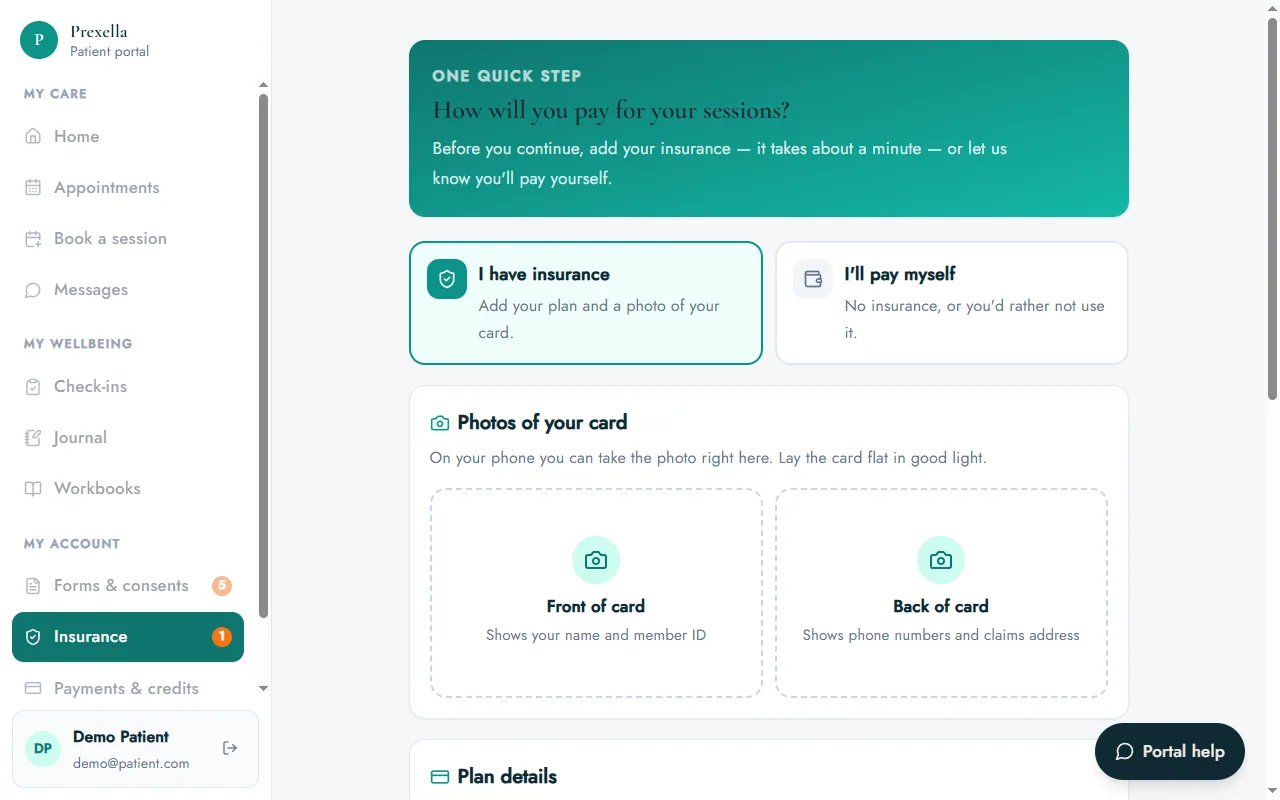
In Prexella, mental health screenings are built into the client portal. Clients can complete the PHQ-9 and GAD-7, along with the PCL-5, AUDIT-C, DAST-10, ASRS and C-SSRS screener, as check-ins. Each is scored automatically against its severity bands and saved to the client's record. Any answer above zero on PHQ-9 item 9 routes the client straight to the C-SSRS screener and flags the result, and new screening results appear in the dashboard notifications so the clinician sees them before the next session. That is therapy practice management software doing what a clipboard cannot.
A worked example: twelve weeks of scores
An illustrative client starts weekly therapy with a PHQ-9 of 16 (moderately severe) and a GAD-7 of 12 (moderate), with item 9 at 0. Measures are repeated every four weeks.
| Week | PHQ-9 | GAD-7 | What the clinician does |
|---|---|---|---|
| 0 (intake) | 16 | 12 | Baseline recorded, treatment plan set |
| 4 | 14 | 11 | Small change; reviews goals with the client |
| 8 | 13 | 11 | Little movement; adjusts the plan and considers a consultation or referral for medication evaluation |
| 12 | 8 | 7 | PHQ-9 down 50% from baseline (response); continues the plan |
Without the scores, week 8 can feel like steady progress, because the client is engaged and sessions go well. With them, the plateau is visible early enough to act. That is the practical case for measurement-based care in a small practice.
Group practices: making it consistent
In a group practice, the value of measurement-based care comes from consistency across clinicians. Agree on which measures every new client completes, the interval for repeats, who reviews flagged results when a clinician is away, and how scores are recorded. Review aggregate trends quarterly: average change in PHQ-9 and GAD-7 scores from intake to twelve weeks, by clinician and by service type. Used carefully and without blame, those numbers show where the practice is doing well and where supervision or training would help.
Children and adolescents
The PHQ-9 and GAD-7 were validated in adults. For adolescents, a modified PHQ-9 (the PHQ-A) exists, and many clinicians use age-appropriate measures for younger children, often with a parent-report version. If you work with minors, choose measures validated for their age, and decide in advance how scores are shared with parents within your consent and confidentiality agreements.
A simple protocol you can adopt this week
- PHQ-9 and GAD-7 at intake for every new client.
- Repeat both every four weeks, or every session for short-term work.
- Review scores at the start of each session where a new one is in.
- Any positive item 9: structured safety follow-up before or at the next contact, documented.
- Review the plan with the client if scores have not improved after eight weeks.
See how screenings fit a psychologist's or counselor's workflow on the pages for psychologists and counselors, or request a demo.
Run your practice from one screen
Booking, superbills, the client portal and marketing on your own domain. See it in a free, one-on-one demo.